Ziplio (Online Media & PDF Suite)
An all-in-one online media compression and conversion suite for images, PDFs, videos, and archives. Built for fast browser-based processing with pdf-lib, pdfjs-dist, and JSZip.
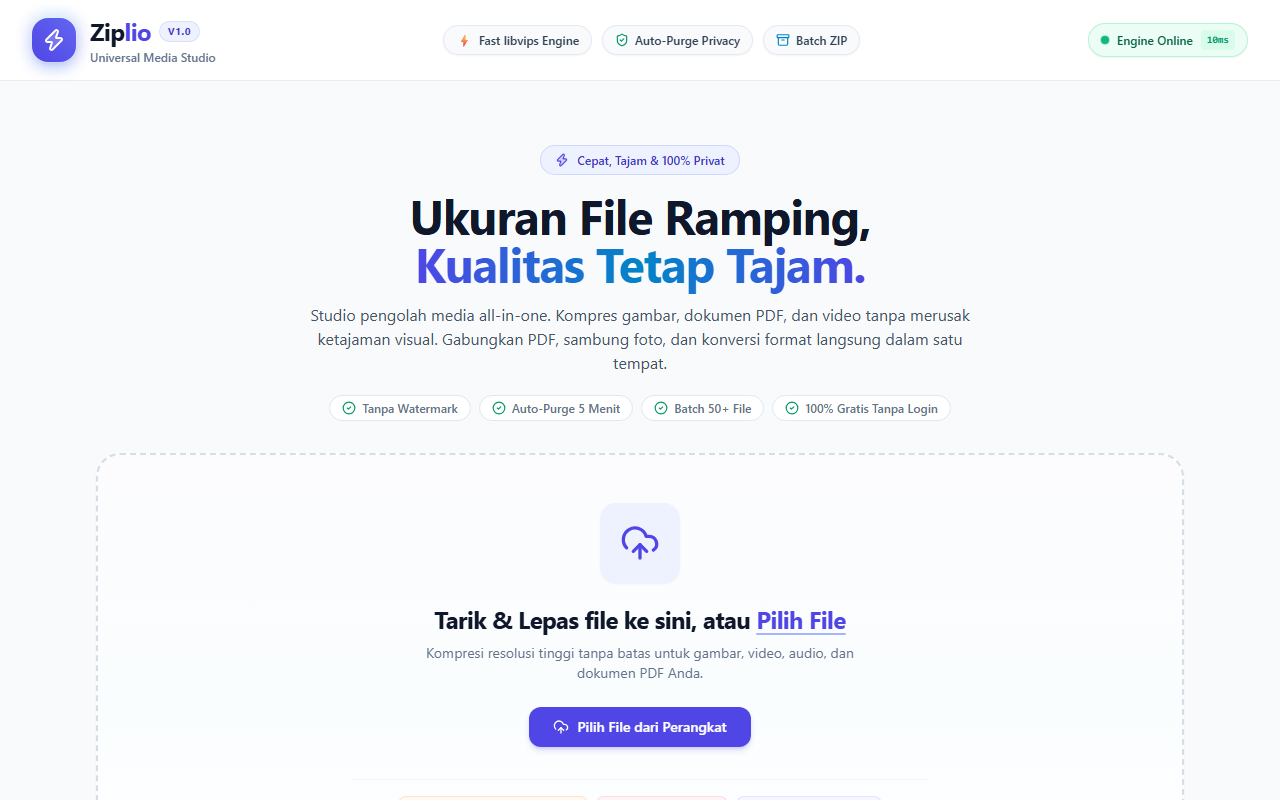
Project Case Study & Overview
Most online file compressors follow the same frustrating pattern: you upload a PDF or a batch of photos, wait through a slow queue, and then hit a paywall, a watermark, or a file-count limit right before downloading. I built Ziplio to give myself and anyone else a fast, clean workspace that compresses images, PDFs, videos, and audio without watermarks or accounts.
Drop your files onto the canvas, pick what you want to shrink or merge, and download the result immediately.
Built Around Speed and Privacy
When people compress personal documents or client assets, they shouldn't have to wonder where those files sit afterward. Ziplio runs on an ephemeral lifecycle: uploaded and processed files are auto-purged every 5 minutes, nothing gets stamped with a watermark, and there is no login wall blocking basic tools.
The header also displays a live engine status pill showing latency in milliseconds, so you know immediately that the libvips processing backend is online and responsive.
What Ziplio Handles
Inside the Tech Stack
The frontend is a React 18 and Vite application styled with Tailwind CSS, clsx, tailwind-merge, and Lucide React. A big reason Ziplio feels snappy is that document work doesn't always wait on a round-trip to the server: pdf-lib and pdfjs-dist handle PDF inspection and manipulation directly in the browser, while JSZip bundles batch outputs into a downloadable archive on the spot.
For heavy image compression and format conversion, requests go to a Node.js and Express server backed by libvips, which processes high-resolution images in a fraction of the time and memory of traditional tools before the auto-purge worker clears temporary disk storage.